
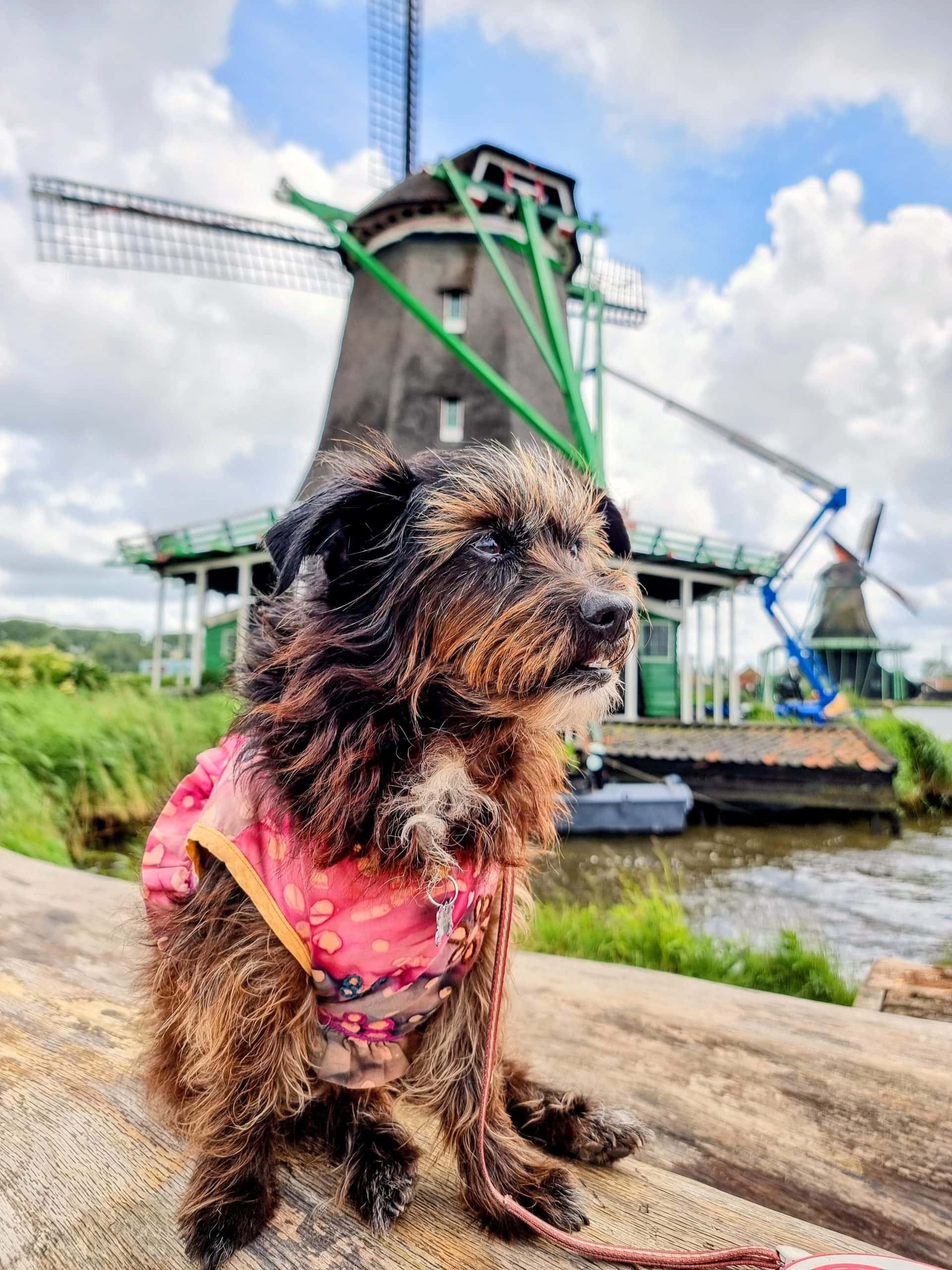
Traveling through the Netherlands with my dog in late May 2025 was calm and easy.
From the start, moving around felt simple and well organised.
In Amsterdam, and later in quieter Dutch villages, public spaces were clean and easy to use.
At the same time, people were welcoming, and daily travel never felt stressful.
In this guide, I share what actually worked for us.
You will also find the key rules, transport basics, and practical tips that made our trip smooth.
TLDR 🔍
- The Netherlands is truly dog-friendly and easy to travel.
- Dogs are welcome on public transport and in many cafés.
- If you follow the basic rules and bring the right documents, the trip feels smooth.
- This guide covers the key rules, transport tips, and real lessons from our journey.
- Dog-Friendly Netherlands: Highlights and Hurdles 🐾
- Before You Go: Legal and Health Rules for a Dog-Friendly Netherlands 🛂
- Dog Breeds & Other Pets: Know the Rules Before You Go 🐈
- On the Move: Pet Transport in the Netherlands 🚆
- Pet-Friendly Places to Stay in the Netherlands 🛏️
- Where to Go and What to Do with Your Dog in the Netherlands 🐾
- Practical Tips for a Dog-Friendly Netherlands Trip 🎒
- Costs and Budgeting for a Dog-Friendly Netherlands Trip 💶
- Final Thoughts 🌷
- FAQs About Dog Friendly Netherlands ❓
- Ready to Travel the Netherlands with Your Dog? 🐾
Dog-Friendly Netherlands: Highlights and Hurdles 🌷
In just two days, our first moments in the Dog-Friendly Netherlands showed both ease and challenge.
This short stop marked the start of our longer journey to Italy.
Overall, traveling with a dog felt simpler than expected, especially when using public transport and visiting cafés.
If you are traveling solo, you may also find my guide to solo pet travel helpful.
It shares clear steps to help you feel more confident before you go.
At the same time, not everything went smoothly.
Several lifts at train stations were out of order, which made moving with a buggy harder.
I also misread a few train connections, a reminder that small mistakes can happen on the road.
Because of this, I learned practical lessons worth sharing.
In this guide, you will find both the highlights and the hurdles.
As a result, you will know what to expect when exploring the Netherlands with your dog.
Before You Go: Legal and Health Rules for a Dog-Friendly Netherlands 🛂
Before your trip to Dog-Friendly Netherlands, make sure your dog meets all legal and health requirements.
Good preparation helps avoid stress, delays, and extra costs at the border.
Traveling from Europe (EU Countries)🔵

If you are traveling from another EU country, the process is simple.
Your dog must have a microchip and a valid rabies vaccination.
The rabies vaccine must be given after the microchip and at least 21 days before travel.
Once these steps are complete, your EU Pet Passport is enough to enter the Netherlands.
No quarantine is required when documents are correct.
Traveling from the UK or Outside the EU
If you are traveling from the UK, the USA, or any non-EU country, the rules are slightly different.
You will need an Animal Health Certificate (AHC) or an EU Veterinary Certificate.
It must be issued by an official vet within ten days before entering the Netherlands.
In some high-risk rabies countries, a blood test is also required.
After the test, a three-month waiting period applies before travel.
For a full checklist on documents, microchips, and vaccines, you can read my full pet travel guide. It covers documents, timelines, and real examples in detail.
Timeline: How Far in Advance to Prepare 📅
Planning ahead makes travel much easier.
In general, allow extra time if you need rabies testing or an Animal Health Certificate.
If you are traveling from the UK, remember that entry must happen within ten days of the certificate issue date.

Quick Checklist: Before You Travel with Your Dog ✍️
Before you leave, double-check the essentials:
🐾 Microchip: Microchip is readable and matches your documents.
💉 Rabies vaccination is valid and correctly dated.
📘 EU Pet Passport or AHC: is correct.
🖋️ Vet Signatures: All pages are signed and stamped by an official vet.
🧾 Paper Copies: are packed.
🐕 Fit to Travel: Check your dog’s health and behaviour before the trip.
📅 Timing rules are respected.
🧳 Extras: Emergency vet contact and insurance details are noted.
An EU Pet Passport cannot be updated, signed, or validated remotely.
Vaccinations and signatures must be done in person by an authorised vet and in the correct country.
Trying to update a passport by mail or after long gaps can lead to denied boarding or border problems.
If you are travelling from the UK or outside the EU, you will need an Animal Health Certificate instead.
Dog Breeds & Other Pets: Know the Rules Before You Go 🐈
Before traveling with your pet, it is important to understand how breed and species rules work in the Netherlands.
Although the country is widely known for being pet-friendly, some regulations still surprise travelers.
Most of these rules focus on animal welfare and responsible ownership.
Therefore, checking the details in advance helps you avoid stress and travel with confidence.
Restricted or Monitored Dog Breeds 🦮
The Netherlands no longer bans specific dog breeds.
Breeds such as Pit Bulls or Rottweilers are allowed to enter the country.
However, any dog can be assessed if it shows aggressive behaviour or causes an incident.
In these situations, authorities may require a behavioural evaluation.
This applies to all breeds, without exception.

At the same time, Dutch law places strong limits on breeding practices.
These rules exist to protect animal health and welfare.
As a result, breeding or selling dogs with extreme physical features is restricted.
This mainly affects flat-faced, also called brachycephalic, breeds.
Common examples include:
- Pugs
- French Bulldogs
- English Bulldogs
You can still travel to the Netherlands with these dogs as personal pets.
Travel is allowed.
The key condition is health.
Your dog must breathe comfortably and be medically fit for travel.
Quick Summary: Flat-Faced Dog Rules in the Netherlands📋
| ❓ Question | 🐾 Answer |
|---|---|
| Can I travel to the Netherlands with a flat-faced dog? | ✅ Yes. Personal pets like Pugs or French Bulldogs are allowed if their documents and microchip are valid. |
| Can I live or breed these dogs in the Netherlands? | ❌ No. Breeding or trading flat-faced dogs with severe breathing issues is forbidden. |
| Can I fly with a flat-faced dog? | ⚠️ Depends on the airline. Many refuse brachycephalic breeds due to breathing risks. |
| Is it safe to travel? | 🟢 Yes, by car, train, or ferry — as long as your dog is healthy and cleared by a vet. |

💡 Tip: The Dutch government actively promotes responsible pet ownership. They encourage everyone to research carefully before choosing a breed, focusing on health and welfare.
Find guidance and heart in my post How to Choose the Right Pet and Build a Lifelong Bond 🐾
Some breeds remain restricted due to welfare concerns and irresponsible breeding practices. If you’d like to understand how these issues still affect dogs today, you can explore my guide on unethical breeding.
Pets Other Than Dogs 🦎
The EU Pet Passport only applies to dogs, cats, and ferrets.
Other animals, such as birds, rabbits, or reptiles, often follow different rules.
In many cases, they require special veterinary certificates or import authorisations.
Because these rules vary, always check the latest guidance from the Netherlands Food and Consumer Product Safety Authority (NVWA) website for updated rules.

Traveling with Horses 🐎

Horses are classified as companion or competition animals.
For this reason, cross-border travel requires specific veterinary certification.
If you are traveling for equestrian training or events:
- Check the TRACES system used within the EU
- Speak with an official veterinarian
- Start the paperwork at least six weeks before travel
Planning early helps avoid delays and unexpected restrictions.
Traveling by Ferry, Train, Car, or Plane ✈️
You can enter the Netherlands by ferry, train, car, or plane.
The type of transport does not change the entry rules for pets.
Once your documents are correct, the process is the same across all routes.
Choose the option that best fits your journey, your dog’s comfort, and your travel style.
Final Note 🌍
The Netherlands welcomes responsible pet travellers.
As long as your companion is healthy, well-behaved, and properly documented, you’ll both enjoy a smooth and stress-free journey.
On the Move: Pet Transport in the Netherlands 🚆
Getting around the Netherlands with your dog is super, super easy.
Honestly, it’s one of the most relaxed pet travel experiences in Europe.
Public transport is clean, reliable, and easy to understand, even for first-time visitors.
More importantly, dogs are part of everyday life.
Seeing pets on trains, trams, and buses feels normal rather than exceptional.
What Traveling with a Dog Feels Like in the Netherlands 🐶

During our journey, Cookie travelled on trains, trams, buses, metros, and ferries without difficulty.
Small dogs usually travel free in a carrier or on your lap.
Larger dogs may need a simple day ticket on trains.
People were welcoming and relaxed.
Many smiled, said hello, or reacted kindly to Cookie’s little buggy.
This local attitude makes a real difference and helps reduce travel stress.
Arriving from the UK is also simple.
Dog-friendly ferries operated by Stena Line or DFDS make the crossing smooth and well organised.
Quick Summary — Pet Transport Rules in the Netherlands 🧭
🐾 Note: Regulations can vary slightly by operator. Always double-check before your journey, especially on replacement buses.
You’ll often see locals cycling with small dogs tucked into bike baskets.
Even ferries and waterbuses welcome pets on board.
🧭 Pet Transport Rules in the Netherlands
| Mode | Ticket for Dog | Carrier / Leash | Seats / Muzzle |
|---|---|---|---|
| NS Trains | Small dogs: free (carrier or lap). Larger dogs: need a Day Ticket Dog. | Carrier or lap; leash required for larger dogs. | No seats; guide dogs travel free. |
| Amsterdam (GVB) – tram / metro / bus / ferry | Usually free for dogs. | Lap, carrier, or short leash. | No seats; guide dogs free. |
| Rotterdam (RET) – tram / metro / bus | Free for all dogs. | Short leash; keep clear of doors. | No seats; follow signage. |
| Other Operators (Arriva, Connexxion, etc.) | Small: usually free in carrier; large: may require a supplement. | Carrier or leash, per company rules. | No seats; check local terms. |
| Replacement Buses | Often not allowed (guide dogs excepted). | — | Confirm in advance. |
This table is designed to give you clarity at a glance and help you plan your journey with confidence.
Want the Full Guide on Dog-Friendly Public Transport?
This section focuses on real-life experience and local rules in the Netherlands.
For a broader overview, including etiquette, apps, and first-time tips across Europe, you can read my dedicated guide.
💛 Dog on Public Transport: everything you need for a smooth ride
Full rules, tickets, apps, and etiquette for trains, trams, buses, and ferries in the Netherlands — stress-free and pet-friendly travel made easy.
🚉 Get the No-Stress Transport Guide
Here’s Cookie showing how easy Dutch trains can be, calm, smooth, and pawsitively pet-friendly.
After discovering how easy it was to move around, Cookie and I were ready for more.
Quiet villages, canals, and countryside were only a short ride away.
Pet-Friendly Places to Stay in the Netherlands 🛏️

Finding truly pet-friendly accommodation in the Netherlands can be trickier than it looks online.
Many hotels are labelled as “pet-friendly”, but only offer a limited number of rooms for guests with pets.
For this reason, confirming details in advance makes a big difference.
Quick Tips Before Booking 💡
- Always call the hotel directly before confirming your reservation
- Ask how many pet-friendly rooms are available
- Check if there are extra pet fees or restrictions
🟧 Confirm Before You Book
Availability can disappear quickly, so it’s safer to confirm in advance by phone. 📞
During our stay in Amsterdam, we chose nhow Amsterdam RAI.
As a result, access by public transport was simple. Moreover, the staff shared an emergency vet contact just five minutes from the hotel.
Where to Go and What to Do with Your Dog in the Netherlands 🐾
Even with a short stay, our Dog Friendly Netherlands journey felt easy and relaxed.
Travelling with a dog felt simple.
Daily plans came together naturally.
In general, dogs are welcome in many outdoor spaces, cafés, and walking areas.
Moreover, some museums and attractions are pet-friendly.
In a few cases, dogs can even enter free of charge.
During our journey, we explored several places across the country.
Each stop felt different, yet consistently welcoming to dogs.
We visited Rotterdam, followed by Zaandam and Zaanse Schans.
After that, we continued to Edam and finished in Volendam.
Together, these towns offered a mix of modern cities, traditional villages, canals, and coastal walks.
Each destination deserves its own space, which is why I share them in separate guides.
Practical Tips for a Dog-Friendly Netherlands Trip 🎒
Practical habits make a real difference when travelling with a dog.
Packing light, keeping routines simple, and focusing on comfort helped our days flow more smoothly.
These small choices reduced stress and made moving between places easier, especially when using public transport or walking long distances.

Costs and Budgeting for a Dog-Friendly Netherlands Trip 💶
Traveling through the dog-friendly Netherlands can be simple and affordable. In general, most daily costs come from transport, meals, and small extras. However, with good planning, it is still possible to enjoy full days without spending too much.
For this reason, the estimates below are based on our own journey.
They reflect a route that included Zaandam, Zaanse Schans, Edam, and Volendam.
As always, prices may vary depending on season, booking time, and availability.
Transport Costs for Our Dog-Friendly Netherlands Trip💶
Using public transport is the easiest way to move between villages. Prices can vary, but most short trips stay within a predictable range. Dogs usually travel for free, which helps a lot.
The table below shows real costs from our trip, shared as a practical example.
| Route / Item | Cost | Notes |
|---|---|---|
| Rail & Sail (UK → Netherlands) | £62.00 | Combined rail and ferry ticket used for our trip. |
| Pet-Friendly Cabin (Stena Line) | £124.00 | Cabin booked for the crossing. Dog travel was included. |
| Environmental Charge (adult) | £9.07 | Mandatory environmental fee applied to passengers. |
| Fees and Use | £1.00 | Standard booking and service charge. |
| Total Ferry Crossing | £192.47 | Total cost for our UK to Netherlands crossing with a pet-friendly cabin. |
| Amsterdam → Zaandam (train) | €3–€4 | NS train. Fast and frequent. |
| Zaandam → Zaanse Schans | €1–€2 | Short train or bus ride. |
| Zaanse Schans → Edam | €4–€5 | Bus 67, then Bus 314. Cookie travelled free. |
| Edam → Volendam | €2–€3 | Quick bus ride. Very dog-friendly. |
| Volendam → Amsterdam | €4–€6 | Bus route. Drivers were kind and helpful. |
Meal Costs 🍽️
Food prices vary by location.
Smaller towns like Edam and Volendam are often cheaper than Amsterdam or Rotterdam.
Typical prices:
- Coffee: €2.50–€3.50
- Slice of cake or pastry: €3.50–€5.50
- Light meal or soup: €8–€12
- Main dish in coastal restaurants: €14–€30
And what about dogs?
During our trip, we did not find restaurants with dedicated dog menus.
However, dogs were welcome in many cafés and outdoor terraces, which made meals relaxed and easy.
Buying dog food was also simple.
Supermarkets were well stocked, and local pet shops offered good-quality options.
Activities and Small Extras 🎟️
Many activities are free, especially walks and outdoor exploration.
Still, you may want to budget for a few small experiences.
Typical costs:
- Ferry or boat crossing: €5, dogs travel free.
- Entry to pet-friendly windmill areas: €5–€7 depending on the mill.
- Souvenirs: €3–€10 for scarves, magnets or local sweets.
Extra Notes for Dog Owners 🐕
Travelling with a dog can slightly affect your budget. Still, the Netherlands makes it easy:
- Dogs travel free on most buses.
- Outdoor seating is normally available.
- Many attractions allow dogs, although not all museums do.
- Rain gear for you and your dog can be helpful, especially in spring.
Final Thoughts 🌷
This short stop in the Netherlands was quietly surprising.
Although I had passed through the country before, this time felt different.
Instead of focusing only on Amsterdam, I chose smaller towns and slower routes.
As a result, our dog-friendly Netherlands journey felt calmer and more personal.
Villages and coastal stops revealed a side of the country that often goes unnoticed.
Travelling with Cookie was easier than expected.
Public transport was simple to use, and people were patient and kind.
Language was never a barrier, which made everyday moments feel relaxed and natural.
Overall, the Netherlands left a lasting impression.
Not only because of its beauty, but because of how welcoming it felt.
Above all, travelling with a dog felt effortless from start to finish.
This guide focuses on the practical side of travelling with a dog.
However, it tells only part of our story.
Each place we visited deserves its own space.
From quiet villages to lively cities, those stories are shared separately, slowly, and in detail.
And this journey?
It didn’t end here.
Key Takeaways ⭐
- The Netherlands is one of the most dog-friendly countries in Europe, especially for public transport and daily travel.
- Proper preparation is essential. This includes microchipping, rabies vaccination, and carrying the correct travel documents.
- Planning the Animal Health Certificate issue date with your vet helps avoid last-minute problems.
- Dogs are widely accepted on trains, trams, buses, metros, and ferries, often with with little or no extra cost.
- Not all hotels labelled as pet-friendly truly are. For this reason, confirming pet policies by phone is strongly recommended.
- Traveling light makes moving through stations, villages, and public spaces much easier with a dog.
- Simple daily routines help dogs stay calm and confident while traveling.
- Kindness toward pets is part of everyday life in the Netherlands, making travel feel genuinely welcoming.
FAQs About Dog Friendly Netherlands❓
To travel to the Netherlands, dogs must be microchipped and vaccinated against rabies.
Travellers from the EU need an EU Pet Passport.
Travellers from the UK or non-EU countries need an Animal Health Certificate issued within 10 days before entry.
Rabies vaccination must be given at least 21 days before travel.
If travelling from the UK, the Animal Health Certificate must be issued within 10 days before entry.
No registration is required for short stays.
If you stay less than three months, no local registration is required.
However, if you plan to stay longer or relocate, you may need to register your dog with a local vet after arrival.
Yes. If you are travelling from a non-EU country, such as the UK, you can use an Animal Health Certificate.
EU pet passports issued in EU countries remain valid.
No tapeworm treatment is required for travel to the Netherlands.
Only microchipping and a valid rabies vaccination are mandatory.
You may be asked to present your dog’s documents at customs.
Officials can check the microchip and vaccination records.
If everything is correct, no quarantine is required.
If documents are missing or incorrect, further checks may be needed.
Ready to Travel the Netherlands with Your Dog? 🐾
If you’re planning a pet-friendly trip and want less stress and more confidence, you’re in the right place.
This guide was built from real experiences, honest lessons, and everyday kindness on the road.
Have you travelled to the Netherlands with your dog?💬
Share your experience in the comments. Your tips might help another pet parent.
Found this guide helpful? 💛
Give it a like, save it for later, or pin it for your next trip.

Want to know who’s behind these paws-on-the-road stories? ✈️
Discover our journey and what led us here.
Ready for the next pawstop? 📍
Follow our trail to more dog-friendly places and unforgettable moments on the road.
Note: The external links are here to help you explore further. I don’t receive any commission for mentioning them . Just sharing what I found useful.
Leave a Reply